

 Mortgage Advice
  30 November, 2025
  Iman Javaid
 For many expatriates, buying a home in the UAE is a milestone, whether for long-term residency, investment, or rental income. But understanding UAE mortgage laws for expats is essential, especially when it comes to repayments, arrears, and what banks are legally allowed to do under UAE property and mortgage regulations.
This guide breaks everything down in clear, practical language so you can make informed decisions without stress or confusion.
How UAE Mortgage Laws Work for Expats
Expatriates make up a significant portion of property buyers in Dubai and the wider UAE. While mortgage access is straightforward, several laws and regulations govern eligibility, borrowing limits, and property rights.
Loan-to-Value (LTV) Rules
The Central Bank of the UAE sets maximum LTV caps. For expats buying residential property:
- First property: up to 80% mortgage for properties valued under AED 5 million
- For properties above AED 5 million: up to 70%
- Second or investment properties: lower caps apply.
Banks may request higher down payments depending on income, employment stability, and credit history.
Eligibility Requirements
Expats usually must provide:
- Valid UAE residency visa
- Stable income/employment
- Minimum salary requirements (bank-specific)
- Good credit score and bank statements
Mortgage Registration
All mortgages in Dubai are registered with the Dubai Land Department (DLD). Registration protects both the bank and borrower, establishing legal ownership rights and mortgage priority.
Early Settlement Rules
UAE law allows borrowers to repay their mortgage early. The maximum early settlement fee is 1% of the outstanding loan or AED 10,000, whichever is lower. This applies to full and partial settlements unless stated otherwise in your contract.
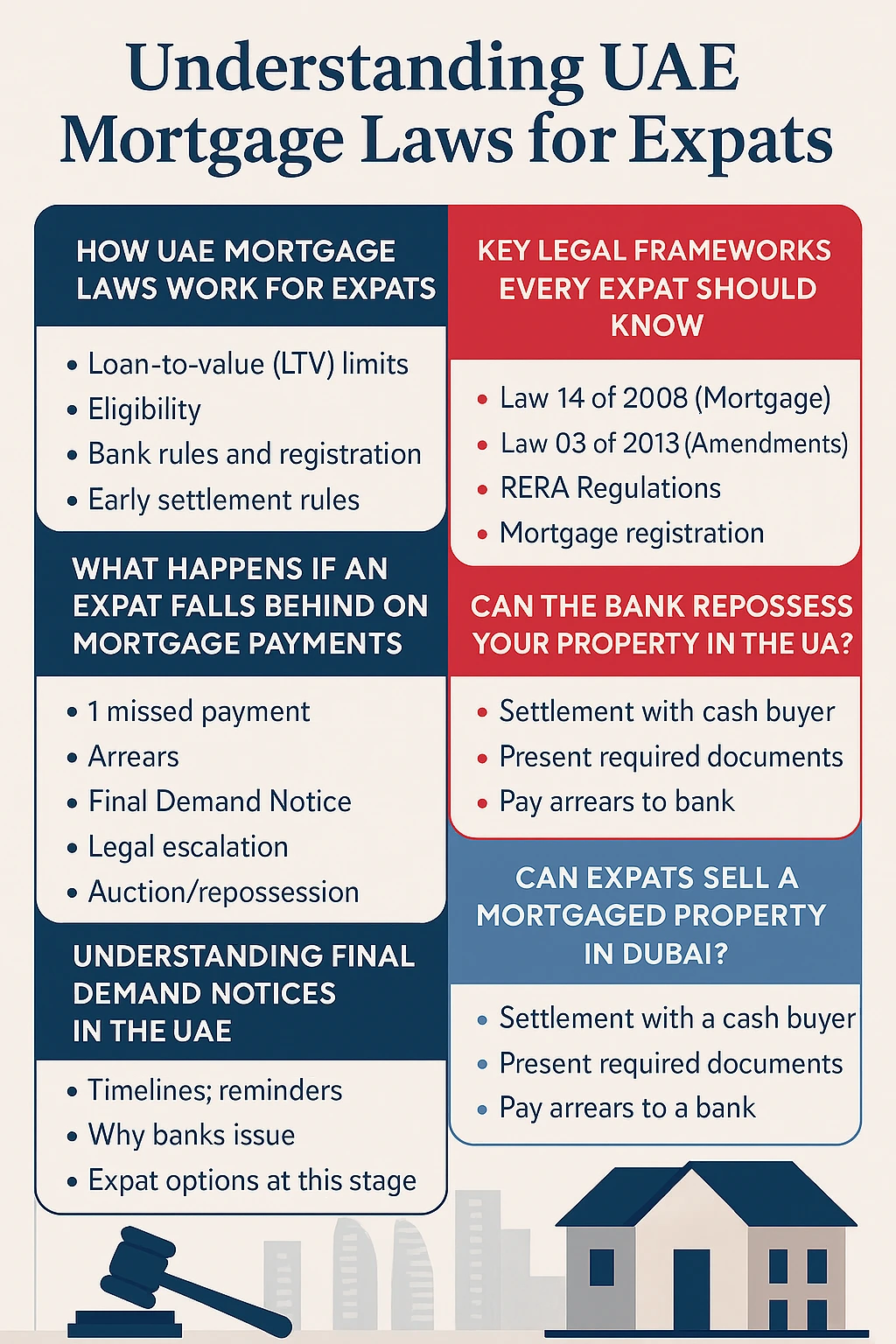
Key Legal Frameworks Every Expat Should Know
Understanding the laws behind mortgage and repossession processes is crucial for expatriate homeowners.
Law 14 of 2008 (Mortgage Law)
This foundational law governs:
- How mortgages must be registered
- Rights of lenders and borrowers
- Conditions for repossession
- Auction procedures
It mandates that repossession cannot occur privately; a bank must follow a structured legal process through the courts.
Law 03 of 2013 (Dubai Land Department Amendments)
This law supports transparency and regulates the roles of banks, developers, and owners. It also strengthens DLD’s enforcement capabilities for mortgage and property registration.
RERA Regulations
RERA ensures fair practices in:
Mortgage advertising
Valuation standards
Property handover
Service charges
Bank Enforcement Rights
Banks do not have the right to evict or repossess a property without court approval. Every step requires official notices, documented arrears, and adherence to the mortgage contract terms.
What Happens If an Expat Falls Behind on Mortgage Payments
Falling into arrears is more common than people realize, especially during job changes, unexpected expenses, or temporary cashflow constraints. Understanding the process can reduce uncertainty.
1 missed payment: Courtesy reminder
Banks typically reach out through SMS, email, or calls. This stage is not considered formal arrears yet.
2-3 missed payments: Arrears stage
The loan becomes officially overdue. Banks may:
- Apply late payment fees
- Request immediate partial repayments
- Freeze or restrict bank accounts (in some cases)
Issuance of a Final Demand Notice
Once arrears reach a certain threshold, typically 60-90 days, the bank may issue a Final Demand Notice, as outlined under UAE mortgage regulations.
Legal Escalation
If the Final Demand Notice is not addressed, the bank may file a case with the Dubai Courts. Only courts can permit the next stage.
Auction Procedure (Mazad)
If approved by the court, the property is scheduled for auction. The Mazad system is used for conducting sales transparently.
Repossession
Repossession is the last step and requires full legal clearance. Banks cannot take possession informally or without court oversight.
This timeline varies by bank and contract details, but the overall structure remains similar.
Understanding Final Demand Notices in the UAE
A Final Demand Notice is one of the most important documents expat owners will receive during arrears escalation.
What It Means
It is a formal communication from the bank requiring immediate repayment of overdue instalments or the full outstanding balance (depending on the case).
Common Timelines
Most banks give a 15–30-day deadline to settle arrears before filing a legal case.
Why do Banks Issue It
- To meet legal requirements
- To notify the borrower of potential escalation
- To provide one final opportunity to settle before court involvement
Options Expats Have
While it is not legal advice, typical, compliant actions include:
- Making partial or full repayment
- Negotiating payment terms directly with the bank
- Selling the property to settle the mortgage before escalating
- Arranging a private cash sale, where a buyer pays the bank directly
You can explore this solution here: Cash for Mortgaged Property in Dubai
Can the Bank Repossess Your Property in the UAE?
Yes, but only after following mandatory legal procedures.
The Legal Process
- Bank issues repeated reminders
- Bank sends a Final Demand Notice
- Case filed in Dubai Courts
- Court reviews arrears documentation
- Property approved for auction
- Property sold through Mazad
The bank cannot:
- Lock you out of the home
- Change the property’s status
- Sell it privately without court approval
Repossession is a structured, reviewed process – not an immediate action.
Can Expats Sell a Mortgaged Property in Dubai?
Yes, expats are fully entitled to sell a mortgaged property in the UAE, provided the mortgage is settled at the time of transfer.
How does the Process work?
- A sale agreement is signed
- Bank issues a liability letter showing the outstanding balance
- Buyer pays the bank directly
- Bank releases the mortgage
- Property transfer is completed at DLD
Many expats choose a cash buyer when:
- Arrears are accumulating.
- A Final Demand Notice has been issued.
- A fast timeline is needed.
- Market conditions make traditional sales slower.
For urgent cases, see our services for stopping repossession here.
Mistakes Expats Should Avoid with UAE Mortgages
To stay compliant and avoid unnecessary escalation, expats should avoid:
Ignoring payment reminders
Even small gaps can grow quickly due to interest and late fees.
Not reading the mortgage contract carefully
Terms around early settlement, arrears, or variable rates often catch people off guard.
Letting arrears accumulate
Banks act faster once arrears cross 60-90 days.
Assuming repossession is immediate
Many owners panic unnecessarily. The process is slow and structured, but early action matters.
Misunderstanding LTV rules
Not factoring in registration fees, valuation, and deposits can lead to funding gaps.
Practical Options for Expats Facing Mortgage Pressure
If you’re feeling financial strain, here are practical, compliant paths:
- Negotiate directly with the bank
Many banks allow payment plans or restructuring within their internal rules.
- Repay overdue instalments
Even partial repayment can pause escalation.
- Bank-approved refinancing
Only through banks, not third-party transfer schemes.
- Sell the property before escalation
A private cash buyer can settle the mortgage directly with the bank, allowing the owner to exit cleanly before any legal action begins.
When to Consider a Fast Cash Sale
A fast cash sale may be worth considering when:
- You’re relocating permanently.
- You’ve lost your job, or your visa status has changed.
- Arrears are rising, and you want to avoid court escalation.
- A Final Demand Notice has already been issued.
- The bank has started early legal steps.
Cash buyers shorten the process significantly because they settle arrears directly with your bank before transferring.
Common Questions Answered about UAE Mortgage Laws
Can expats legally own mortgaged property in Dubai?
Yes. Expats can legally own freehold and mortgaged property in designated freehold areas.
How does expat repossession differ from UAE nationals?
The legal process is effectively the same, following mortgage law, court approval, and auction procedures.
How long before a bank starts foreclosure in the UAE?
Typically, after 60-90 days of arrears, but it varies by lender and contract terms.
What is the process of selling mortgaged property?
Obtain a liability letter, secure a buyer, repay the bank, release the mortgage, and transfer ownership.
Can you stop a UAE property auction?
If the arrears are settled before the court finalizes auction orders, the case can often be paused. This depends on bank and court approval.
Can expats settle mortgage arrears before legal escalation?
Yes. Banks generally accept arrears settlement before filing a court case.
Is early settlement allowed for expat mortgages?
Yes. The law caps early settlement fees at 1% or AED 10,000.
Need a Fast, Private, Bank-Compliant Sale?
If you’re an expat facing mortgage arrears, legal pressure, or relocation, Express Sale Dubai can arrange a confidential, fast, bank-compliant cash sale to settle your mortgage directly with your bank.
No restructuring claims. No transfer schemes. Just a clear, safe exit.
Contact us today for a discreet consultation.